
Deep-Nested JSON-LD: Building True Entity Architecture
The Problem with "Flat" Schema
If you install a basic SEO plugin, it will typically inject structured data onto your page. It might output a script that says "This is an Article" and another script that says "This is an Organization."
To a novice, this looks like a win. But to Google's Natural Language Processing (NLP) algorithms, it is a disconnected mess. This is known as Flat Schema.
In flat schema, the entities exist on the same page, but they have no mathematical relationship to one another. Google is forced to guess: Did this Organization write this Article? Is this Article part of a larger Website? Does this Person work for this Organization?
When you force an AI engine to guess, you bleed topical authority.
What is Deep-Nested JSON-LD?
Deep-nested JSON-LD (often utilizing the @graph array and @id referencing) solves this by explicitly chaining entities together into a definitive hierarchy. Instead of just listing things that exist on a page, nested schema maps exactly how they interact.
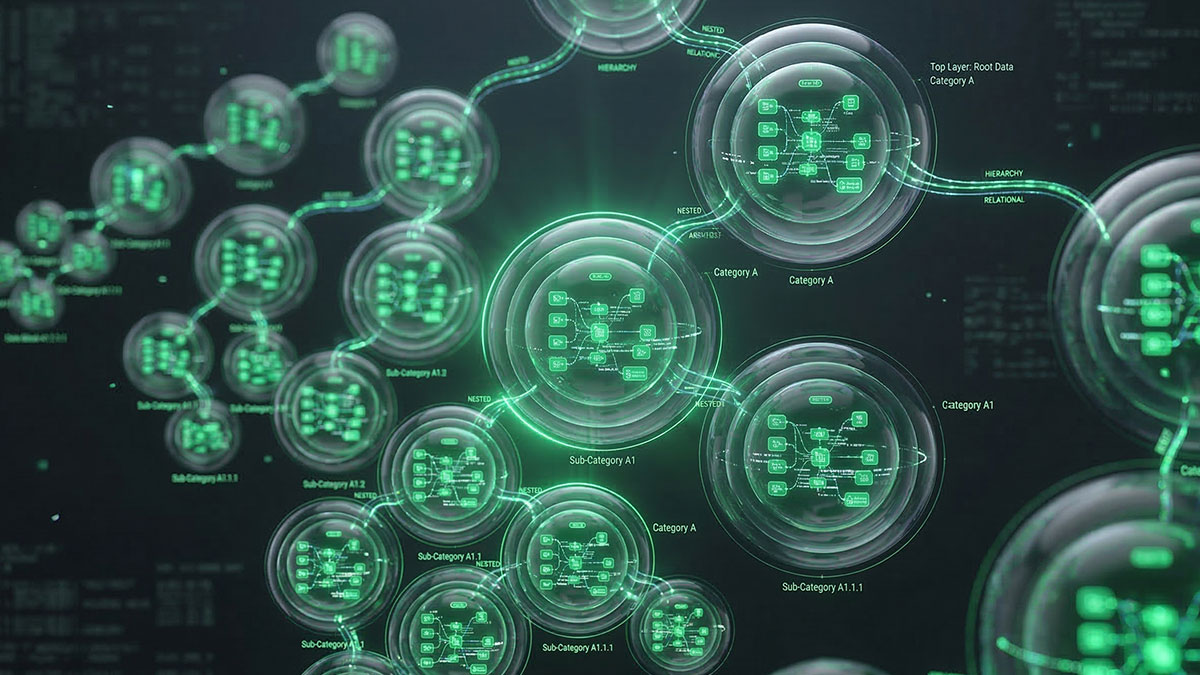
The Anatomy of a Semantic Chain
A properly nested Knowledge Graph reads like a flawless logical statement:
- This Article...
- ...is authored by this Person...
- ...who is the Founder of this Organization...
- ...which publishes this WebSite.
By chaining these nodes together using @id references, you eliminate all ambiguity. Google instantly absorbs your entire E-E-A-T profile in milliseconds.
Why Manual Nesting is a Nightmare
Understanding the value of deep-nested schema is easy. Actually writing the code is brutal. A single misplaced comma, an unclosed bracket, or a broken @id URL reference will invalidate the entire script, resulting in Search Console errors and zero rich results.
// Example: The complexity of manual @id referencing
"author": {
  "@id": "https://yoursite.com/#person-kris"
},
"publisher": {
  "@id": "https://yoursite.com/#organization"
}
Attempting to manually hardcode this logic across hundreds of blog posts, service pages, and local business listings is unscalable for any agency or creator.
The SPP Automated Semantic Engine
This is the exact problem Schema Pillar Pro was engineered to solve. SPP acts as an on-premise semantic engine that handles the deep-nesting architecture for you automatically.
- The Global Node: You set up your Organization and Founder details once in the Global Identity Dashboard.
- The Automated Assembly: When you use one of SPP's 27 Schema Builders on a page, the plugin automatically fetches your Global Identity nodes and perfectly nests them into the new schema payload.
- Flawless Output: SPP guarantees syntax-perfect, fully validated JSON-LD output every single time, formatted exactly how Google's Knowledge Graph prefers to ingest it.
Build the Graph, Dominate the SERPs
In the era of AI Overviews, whoever provides the most structured, unambiguous data wins. Stop feeding search engines flat, disconnected tags. Upgrade to deep-nested JSON-LD with Schema Pillar Pro and force Google to recognize the true depth of your Entity Authority.